THE 2026 MIDIS DU FESTIVAL
FROM 2 TO 21 JULY, 17 FREE PUBLIC ENCOUNTERS GATHER ARTISTS AND PROFESSIONALS AROUND THE 2026 PROGRAMME
Share
— THURSDAY 2 JULY AT NOON
AROUND ACCABADORA
With Francesco Filidei (composer), Valentina Carrasco (stage director) and Francesco Leone (performer)
— FRIDAY 3 JULY AT NOON
AROUND THE WOMAN WITHOUT A SHADOW
With Barrie Kosky (stage director)
A conversation led by Judith Chaine
— SATURDAY 4 JULY AT NOON
AROUND THE MAGIC FLUTE
With Clément Cogitore (stage director) and Antoine Lilti (historian, professor at Le Collège de France and at EHESS)
Sarastro’s final victory over the Queen of the Night appears to express the hope of an imminent triumph of reason, knowledge and justice over obscurantism and superstition, a reading that has traditionally made The Magic Flute an opera of the Enlightenment. Yet what blind spots are inevitably contained within every utopian vision, whether in the West of yesterday or today? What shadow does this light itself cast? This discussion brings together Clément Cogitore, director of the 2026 production of The Magic Flute, and Antoine Lilti, Professor at Le Collège de France and a specialist in the legacy of the Enlightenment, to place the production presented at the Théâtre de l’Archevêché in a broader perspective.
— MONDAY 6 JULY AT NOON
AROUND THE ACADÉMIE’S LIBRETTO RESIDENCY: WHAT LIBRETTOS FOR TODAY’S OPERA?
With Piersandra Di Matteo (dramaturge), David Levin (dramaturge), Antonio Cuenca Ruiz (dramaturge in residence), Agnese Cornelio (dramaturge in residence) and Francesco Filidei (composer of Accabadora)
The Académie du Festival d’Aix-en-Provence seeks to encourage the emergence of new operas. Its 2026 Libretto Residency welcomes artists wishing to create a text that will serve as the basis for music, performance and staging. This roundtable explores the challenges facing librettists today, whether adapting literary traditions, constructing new narratives, or inventing forms of dramaturgy suited to our own time. Alongside the residency’s mentors and the composer Francesco Filidei, a new generation reflects on this vital aspect of the operatic creative process.
— TUESDAY 7 JULY AT NOON
THE ORCHESTRA: A MUSICAL UTOPIA?
With Peter Paul Kainrath (general director of Klangforum Wien), Rebecca Ranson (manager at the London Symphony Orchestra Discovery) and Pauline Chaigne (director of the Orchestre des Jeunes de la Méditerranée)
In a world marked by tense geopolitical circumstances, what artistic and institutional utopias can orchestras bring into being? The power of collective music-making seems more necessary than ever in confronting the dangers of identity-based withdrawal and fostering the human polyphony that the world so urgently needs. Drawing on major symphony orchestras in residence at or invited to the Festival, this roundtable highlights the ambitious artistic and civic projects undertaken by the London Symphony Orchestra, the Orchestre des Jeunes de la Méditerranée and the Klangforum Wien’s ‘Tower of Babel’ programme.
— WEDNESDAY 8 JULY AT NOON
OPERA IN SEARCH OF HUMANITY
With Raphaël Pichon (conductor of Requiem) and William Marx (professor of comparative literature at Le Collège de France)
By placing the 2026 Festival’s theme of ‘In Search of Humanity’ in perspective, this discussion explores what makes opera not merely a reflection of the world, its difficulties and its upheavals, but also an invitation to reconnect with our shared humanity through an optimistic lens. To this end, opera constructs collective narratives, exemplary journeys and formative experiences. As the quintessential total artwork, larger than life and more intense than life itself, opera offers a privileged means of approaching the essence of the human condition.
— THURSDAY 9 JULY AT NOON
GROWING UP: FROM SCHOOL TO THE STAGE, CHILDREN IN OPERA
With Rachel Masclet (performer of Accabadora), Theresa Schmitz (musicologist), Manon Bohn (production administrator – Festival d’Aix), Hasnaa Bennani (vocal coach of Requiem), Chadi Larzeq (performer of Requiem in 2019) and Frédérique Tessier (Passerelles manager – Festival d’Aix)
A conversation led by David Christoffel (Metaclassique)
From the Three Boys in The Magic Flute to the children who appear in Requiem and The Woman without a Shadow, and the young Maria in Accabadora, the operas staged at this year’s Festival accord a special place to child characters. As childhood and its imaginative world have been increasingly revalued, their presence has become a major dramaturgical concern. Yet questions of representation are accompanied by issues of training and education, whether in a professional context or simply as part of artistic development. How, then, should we think about the contribution made by children to opera, both on stage and within the works themselves? How can we help them grow through and alongside artistic practice?
— FRIDAY 10 JULY AT NOON
OPERA AND ECOLOGY
With Frédérique Aït-Touati (stage director, researcher, director of the Cité internationale), Piersandra Di Matteo (dramaturge), Tiphaine Colombain (responsible for coordinating the COFEES network) and Frédéric Lyonnet (deputy technical director – Festival d’Aix)
On the occasion of the revival of Romeo Castellucci’s Requiem, this roundtable examines the many facets of the ecological question in opera today, at a time when the disappearance of living species and the collapse of ecosystems have become impossible to ignore. What narratives, forms of dramaturgy, production models and organisational approaches must be imagined for the opera of tomorrow?
— SATURDAY 11 JULY AT NOON
WOMEN ON THE PODIUM: A NEW GENERATION OF CONDUCTORS
With Lucie Leguay (conductor of Accabadora, woman conductor in residence of the 2023 Académie), Arianna Radaelli (woman conductor in residence of the 2026 Académie) and Lamar Elias (conductor assistant of the Symphonic Session of the OJM, semi-finalist of La Maestra 2026)
A conversation led by Judith Chaine
Between 2024 and 2026, only 23 per cent of conducting posts were entrusted to women, despite the increasingly broad access women now enjoy to the profession of conductor. In recent years, a number of initiatives have worked to improve the representation of women in classical music and opera, while supporting their careers, including La Maestra International Competition and Academy for Women Conductors, as well as the mentoring programme for conductors within the Académie du Festival d’Aix-en-Provence. This discussion shines a spotlight on four conductors appearing at the Festival this summer as they reflect on their inspiring careers.
— MONDAY 13 JULY AT NOON
AROUND THE WOMAN WITHOUT A SHADOW
With Volker Krafft (conductor assistant) and Bernard Banoun (professor and Strauss scholar)
— TUESDAY 14 JULY AT NOON
AROUND THE WOMAN WITHOUT A SHADOW
With performers Vida Miknevičiūtė (The Empress) and Ambur Braid (The Dyer's Wife)
— WEDNESDAY 15 JULY AT NOON
AROUND THE MAGIC FLUTE
With performers Sabine Devieilhe (The Queen of the Night), Edwin Crossley-Mercer (Speaker of the temple) and Emma Fekete (Papagena)
— THURSDAY 16 JULY AT NOON
DISCUSSION
With Layale Chaker (violinist and composer)
— FRIDAY 17 JULY AT NOON
AROUND THE MAGIC FLUTE
With Leonardo García-Alarcón (conductor)
— SATURDAY 18 JULY AT NOON
AROUND EL CIMARRÓN
With Elayce Ismail (stage director), Marie-Claude Bottius (lyrical artist) and Jean-Marc Zvellenreuther (guitarist)
Based on the extraordinary life story of Esteban Montejo, born into slavery in Cuba at the end of the nineteenth century, later a marrón (runaway slave), and eventually a fighter in the island’s struggle for independence, El Cimarrón raises the question of the musical and theatrical representation of enslaved people. Reflecting on the role of opera in shaping memories of slavery, particularly through models inherited from the operatic traditions of the eighteenth and nineteenth centuries, this roundtable explores the contemporary resonances of Hans Werner Henze’s work.
The event is supported by the Foundation for the Memory of Slavery
— MONDAY 20 JULY AT NOON
ABOUT THE INSTITUT FRANÇAIS’S MEDITERRANEAN SEASON 2026
With Julie Kretzschmar (general commissioner of the Institut français’ Mediterranean Season 2026) and Pauline Chaigne (director of the Orchestre des Jeunes de la Méditerranée)
For many years, the Festival d’Aix-en-Provence has worked to foster intercultural dialogue across the Mediterranean, notably through the Orchestre des Jeunes de la Méditerranée. Its artistic policy builds bridges, celebrates diversity and gives a voice to a new generation of artists who, through their talent and commitment, are shaping a Mediterranean region that is open, bold and united, while always striving for the highest standards of excellence. As part of the Institut français’s Mediterranean Season 2026, this MIDI initiates a conversation on the necessity on artistic cooperation across the Euro-Mediterranean region.
— TUESDAY 21 JULY AT NOON
DISCUSSION
With Ted Huffman (general director of the Festival d’Aix)
The MIDIS are led by Timothée Picard, Anne Le Berre et Guillaume Picard, dramaturges of the Festival d’Aix.
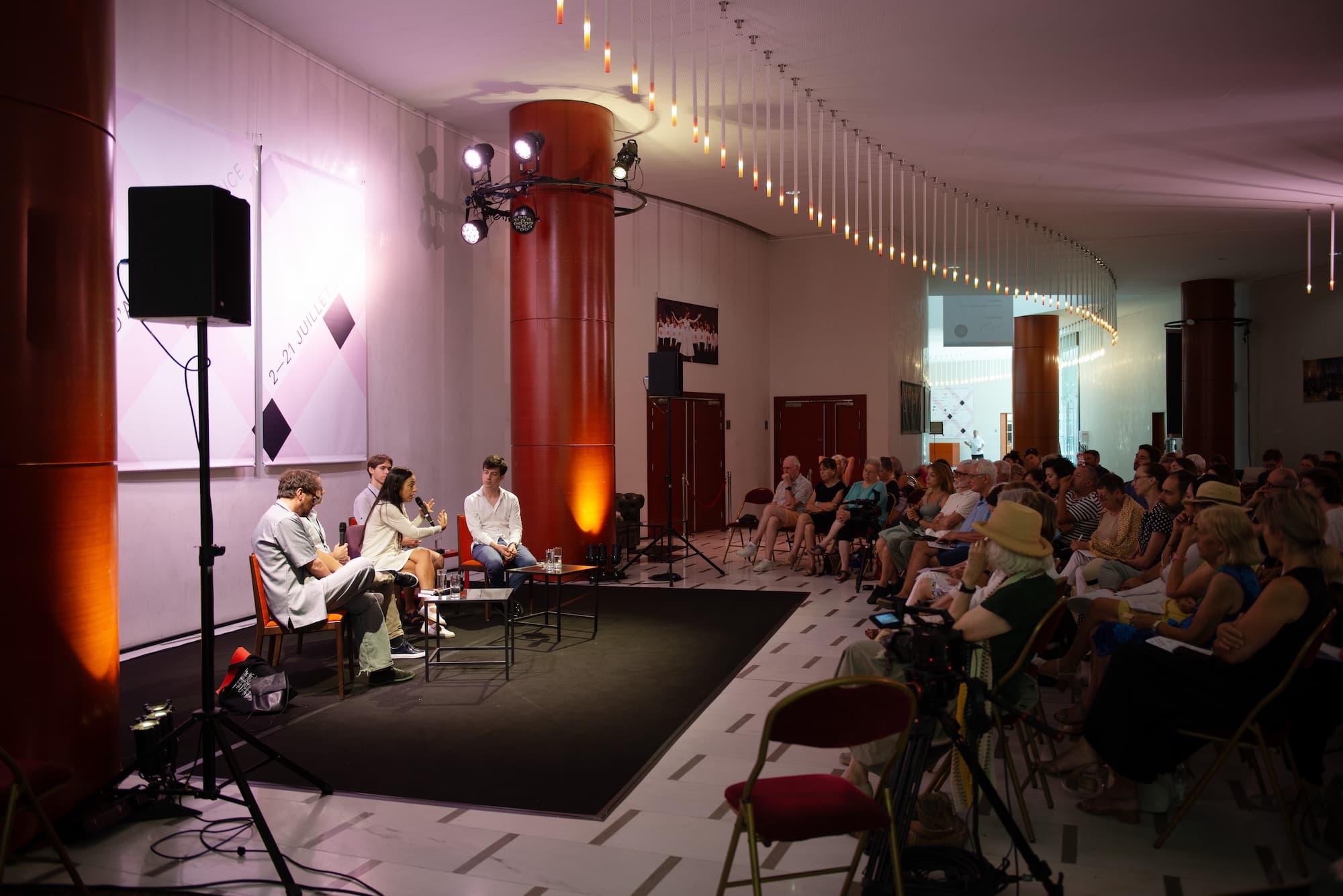
Festival d'Aix-en-Provence 2026 © Laurie Wagner
Performances
FREE ADMISSION, SUBJECT TO AVAILABILITY
THESES ENCOUNTERS AND PANEL DISCUSSIONS WILL BE RECORDED AND AVAILABLE AS PODCASTS OR VIDEOS ON #THEDIGITALSTAGE
List of speakers subject to change.
