[ REHEARSAL NOTES ] REQUIEM
Share
18 June 2026, 9:30pm — Théâtre de l’Archevêché — Festival d’Aix-en-Provence
It would be an understatement to say that, on this mid-June evening, an atmosphere of good humour hangs over the Théâtre de l'Archevêché. One could almost imagine an exuberant school class, brimming with energy and just a little overexcited, were it not for the fact that all the artists gathered for this piano stage rehearsal are consummate professionals who, the very moment the conductor announces the start of the rehearsal, regain complete calm and absolute concentration. Pygmalion, the ensemble founded twenty years ago by Raphaël Pichon, has taken up residence at the theatre to revive Requiem, created with Romeo Castellucci at the Festival in 2019. More than a production, Requiem has become a long-term artistic adventure, bringing together a close-knit team of performers who have presented it all over the globe. These artists are clearly delighted to come together for a project that has become iconic and that, in 2026, will return to the place where it first began: the courtyard of the Théâtre de l'Archevêché in Aix-en-Provence.
The evening rehearsal begins at one of the most intense moments in both the score and the staging: the “Confutatis”. In this section of the Mass for the Dead, the souls of the damned are condemned to burn in Hell for eternity, while the righteous are welcomed into Paradise. To portray this, Mozart alternates between two sharply contrasting worlds: a frenzied, menacing men’s chorus embodying an apocalyptic vision, and an angelic women’s chorus evolving in gentle, suspended lines. The entire Pygmalion chorus is required on stage to perform a choreography driven by an obsessive rhythmic pulse, during the course of which earth and paint are in use. For this rehearsal, which is taking place not in costume but in street clothes, plastic protective coveralls have been handed out to all the chorus members and dancers to protect their clothing from dirt and splashes. The result, a few minutes before the rehearsal begins, is a cheerful hubbub, a bustling coming and going of figures clad in pink or blue transparent plastic hoods, with matching shoe covers. The choristers seem thoroughly delighted by the situation and hand one of the overalls to Raphaël Pichon. Although he has no need of it, since he conducts from the orchestra pit, he happily joins in the fun. He vanishes backstage for a minute before reappearing bedecked in a pink overall that accentuates his tall frame. The moment is simply too good not to capture. Raphaël Pichon joins the chorus and dancers, stretching out in front of them at the front of the stage for a brief, but thoroughly delightful, impromptu photo session.
Work now resumes in earnest. Raphaël Pichon, who is fond of wandering barefoot around the Théâtre de l’Archevêché, takes a leap down into the orchestra pit and goes back to his podium. This rehearsal is as much about refining the staging as it is about the music, and the conductor knows exactly how to communicate with the singers, with whom he works in close collaboration. He peppers his instructions with highly evocative images, poetic for the outside observer, but above all remarkably precise for those who have learnt to interprete them and integrate them into their performance. The “Lacrimosa”, Raphaël Pichon explains, should be barely sung, suspended in the air, in a celestial pianissimo. By contrast, in the “Confutatis” he asks for consonants that are firmly rooted in the earth trodden by the dancers.
The choreography devised by Evelin Facchini, who is also working this summer alongside Clément Cogitore on his production of The Magic Flute, brings a refreshing vitality to the production. Around a maypole, the chorus and the dancers carefully weave together red and gold ribbons in a repetitive circular dance, watched over attentively by Facchini. At one point, she even joins the movement herself, dancing alongside the performers to guide each posture with precision and instil a greater sense of unity throughout the ensemble. Nor is the choreographer the only one hard at work in this throng. Héloïse Sérazin, responsible for the revival of Romeo Castellucci’s staging, follows the progress of the performance from her large, heavily annotated score. On several occasions, she interrupts the rehearsal over the microphone to rebalance the disposition of performers on stage, to point out a neglected movement, or to signify that a prop has not been placed in the correct position. She can rely on the support of Simone Gatti, with whom she forms a remarkably effective duo, ensuring that the intentions of the original creative team are respected with the utmost fidelity in their absence. The dancer, who has been part of the production since its creation, has taken part in every tour of Requiem. A living repository of the production, with its choreography ingrained in his body, he moves constantly between the stage and the auditorium, lending his experienced eye to Héloïse Sérazin’s. The following day’s schedule includes rehearsing a new scene in the studio, and so Simone asks the performers not to attempt the choreography from memory for the time being. Some things simply cannot be left to approximation, and the work here is pursued with the same rigour as that which precedes the creation of an entirely new production.The dancers are certainly no less enthusiastic than anyone else. Barely has the break been announced than they launch into an impromptu competition of fouettés on the stage, still strewn with earth.
In just a few days, the Pygmalion orchestra will arrive, completing the company for the final rehearsals before the opening of the Festival. Amid this fascinating blend of unbridled good humour and intense concentration, it is the sheer splendour of the choir’s sound that leaves the deepest impression on everyone gathered this evening in the courtyard of the Théâtre de l’Archevêché. So harmonious, so rich, so supple, it bears witness to the profound rapport shared by all the artists present and is placed at the service of a work whose message is both universal and profoundly uplifting. By the time we realise that night has quietly fallen, it is with a broad smile that we leave the rehearsal of this work written for those who are no longer with us, certain of having witnessed a moment of collective joy.
Anne Le Berre and Guillaume Picard
English translation by Christopher Bayton
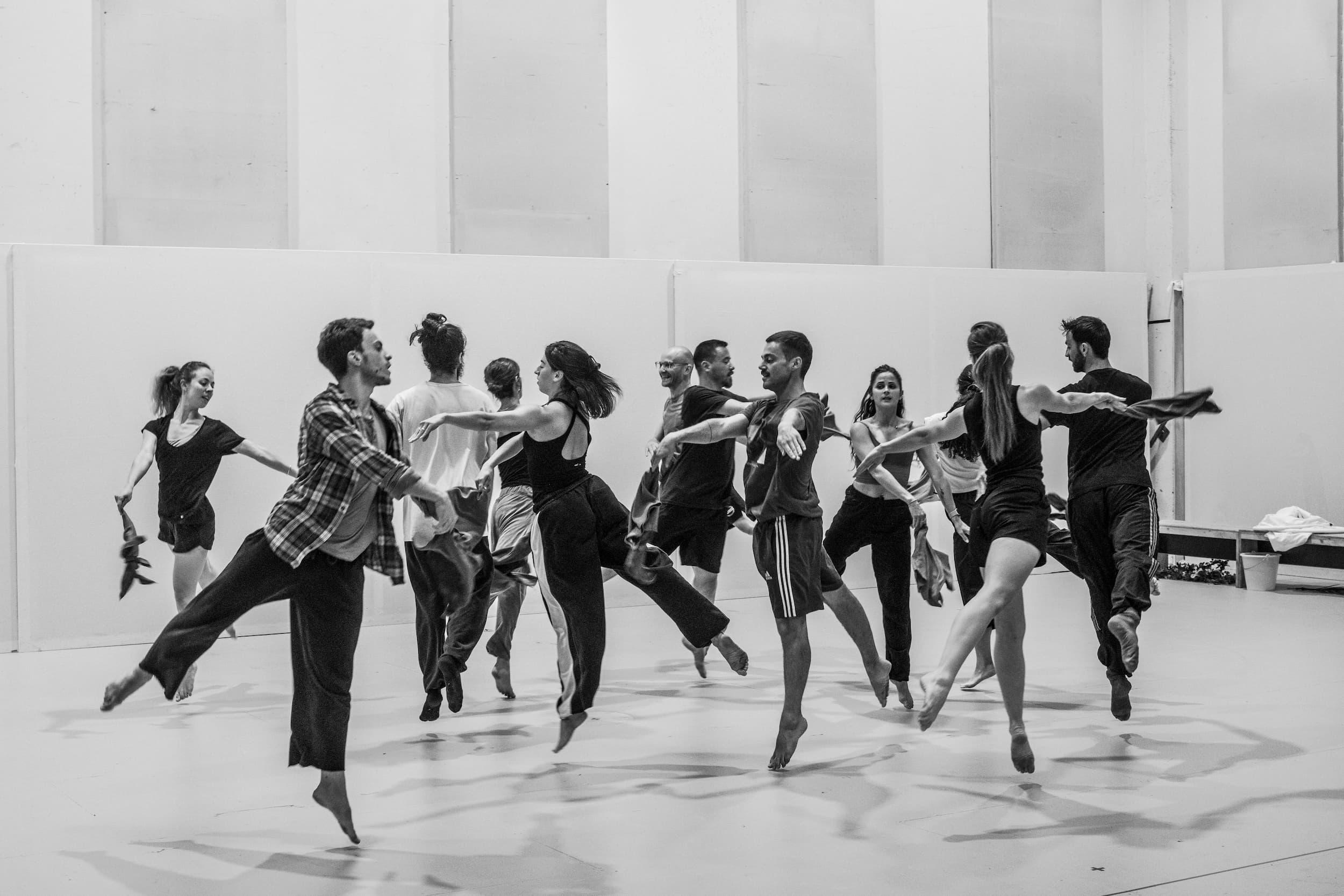
Requiem - Festival d'Aix-en-Provence 2026 © Jean-Louis Fernandez
