[ REHEARSAL NOTES ] ACCABADORA
Share
Wednesday 17 June 2026, 2.30 p.m. — Théâtre du Jeu de Paume — Festival d’Aix-en-Provence
The heatwave has begun to take hold, and yet activity at Le Théâtre du Jeu de Paume is in full swing, with just three weeks to go before the first performance of Accabadora, the new opera composed by Francesco Filidei. Tucked away amongst the narrow streets of Aix-en-Provence’s historic centre, this intimate eighteenth-century theatre feels like a haven of coolness in the early afternoon. Having passed the stage door, we encounter a buzzing hive of activity, in stark contrast to the torpor of the surrounding streets. Every corner of the theatre is occupied. Upstairs, the singers are getting ready in their dressing rooms; costume assistants manoeuvre clothing racks through the corridors leading to the stage; and set designer Mariangela Mazzeo has taken over the public areas, spreading out one of the stage curtains there, a vast black fabric from which she is cutting strips to refine its pleating and texture.
In a large dressing room, a final music rehearsal is underway, while in the auditorium stage director Valentina Carrasco cheerfully puts the female extras through their paces, revising their stage movements. The whole theatre is humming with conversations in French and Italian, the effortless and joyful movement between the two languages adding to the atmosphere. Several seats in the orchestra stalls have been removed to make room for the technical control desks. The theatre is becoming the setting for this adaptation of Michela Murgia’s novel and is gradually transformed into an imaginary Sardinian village, where the opera’s story unfolds. Tzia Bonaria, a seamstress who takes in the young Maria as her fill’e anima (‘daughter of the soul’), gradually reveals herself to be the custodian of mysterious duties, accompanying the dying on their final journey.
As is always the case in opera, the spectacle is not confined to the stage. Elderly women, portraying both the Fates and the community that surrounds the young Maria and Tzia Bonaria, wait in costume in the audience seats.
‘Come along, ladies, let’s get going on the scene changes!’
The rapport between the six women and Valentina Carrasco is genuinely touching. The Argentine stage director knows how to put them at ease and fine-tune their movements, while also making sure they have had something to drink before rehearsals begin. In the first balcony, two six-year-old girls, who appear at the beginning of the opera playing Maria as a young child, are patiently waiting for their turn. It is their very first day in a theatre. Leaning over the balcony above the orchestra stalls and watching their elders down below, they observe this unusual environment with intense curiosity before lifting their eyes in wonder towards the ceiling.
‘The chandelier is so beautiful!’ they exclaim.
The rehearsal begins. Valentina Carrasco and her assistant, Lorenzo Nencini, are on stage alongside the female extras. Standing in for the soloists, who are still in a music rehearsal, they mime their positions as points of reference, slipping from one character to another while giving stage directions and movement cues. Dressed in white, Valentina Carrasco’s figure moves through a set composed of multiple layers, recreating a timeless rural Sardinia. Intent on kneading bread or working the earth, the female extras perform a meticulously choreographed sequence inspired by ancestral Sardinian traditions. After a thorough sweeping of the stage to clear away a fine coating of flour, a substance that appears in many forms throughout the production, the afternoon enters its second phase. It is now the turn of Lucie Leguay, the production’s conductor, to enter the auditorium. With a determined stride, she crosses the stage and descends a walkway spanning the orchestra pit, which is still devoid of musicians, but where a piano is in place for rehearsals. The conductor takes up her position on a high chair facing her music stand and the two imposing volumes that make up the full score of Accabadora. Yoan Héreau, assistant conductor and vocal coach, sits in the front row of the auditorium just behind her. Together with Marco Schirru, répétiteur, vocal coach, and Italian-language coach, the three of them have been working tirelessly for the past four weeks to bring Francesco Filidei’s score to life, adjusting the balance of the chorus voices and refining the soloists’ parts.
The singers gradually begin to arrive, entering the auditorium through different doors and appearing to converge on the stage as if to bring the opera to life. Within seconds, the Sardinian Francesco Leone, himself a fill’e anima (‘child of the soul’) of the novelist Michela Murgia, the tenor Hugo Brady, and the very young soprano Rachel Masclet, whose voice still retains an adolescent timbre, are in place on stage, performing the roles of Andría and Maria respectively. The two little girls make their way down to the stage in turn for their rehearsal and step onto it for the very first time. A few instructions are given to help them find their bearings, while Noa Frenkel, who is portraying the Accabadora, crosses the auditorium in her long black skirt, a smile on her face. Valentina Carrasco and Lorenzo Nencini have returned to their production desk in the middle of the orchestra stalls. From just a few metres away, they watch a run-through of the opening scenes of the opera. A run-through, though not exactly as one of the aims of the session is also to rehearse all the scenes involving the two young girls, who will alternate in the role. Taking advantage of a pause, Rachel Masclet approaches the edge of the stage to ask Yoan Héreau for clarification on a rhythmic detail. Meanwhile, Victoire Bunel, Olga Siemieńczuk, Camille Primeau, Lovro Korošec, Constantin Goubet, and Lodovico Filippo Ravizza take the opportunity to observe what is happening on stage. Alternately positioned on stage and in the orchestra pit, the six members of the coro experiment with vocal placement, adapting the sound they have developed in the rehearsal studio to the acoustics of the theatre. Francesco Filidei’s writing makes the voices twirl around in the style of the canto a tenore – a traditional Sardinian polyphonic chant – with shimmering and unsettling tones.
A short break is announced by production stage manager Lise Labro, and then work resumes for another hour and a half. In the opening scene, the acting is already striking in its sincerity: the dark figure of the Accabadora becomes an adoptive mother in a poignant symbolic gesture, without a single word being spoken. During the rehearsal, the frame of a full-length mirror, a crucial element of the set, is delivered. It is quickly put into place, lending a new dimension to Rachel Masclet’s stage performance. Endlessly inventive and driven with a pace that never slackens, the production takes shape amid an atmosphere of exhilarating energy. Curtains of trailing vines rise and descend from the flies; sturdy wooden tables are rearranged to create constantly shifting stage spaces; vast draperies conceal and reveal swift changes of mood; the ringing of bells heralds the furtive arrival of masked figures, who vanish as quickly as they appeared.
The energy of these scenes is matched only by the dynamism of Valentina Carrasco, the concentration of Francesco Filidei, following rehearsals attentively from the second balcony, the determination of Lucie Leguay, the enthusiasm of the singers, the commitment of the female extras, and the precision of the technical teams: so many creative forces united in bringing into being a chamber opera whose breathtaking effectiveness is already becoming evident.
Anne Le Berre
English translation by Christopher Bayton
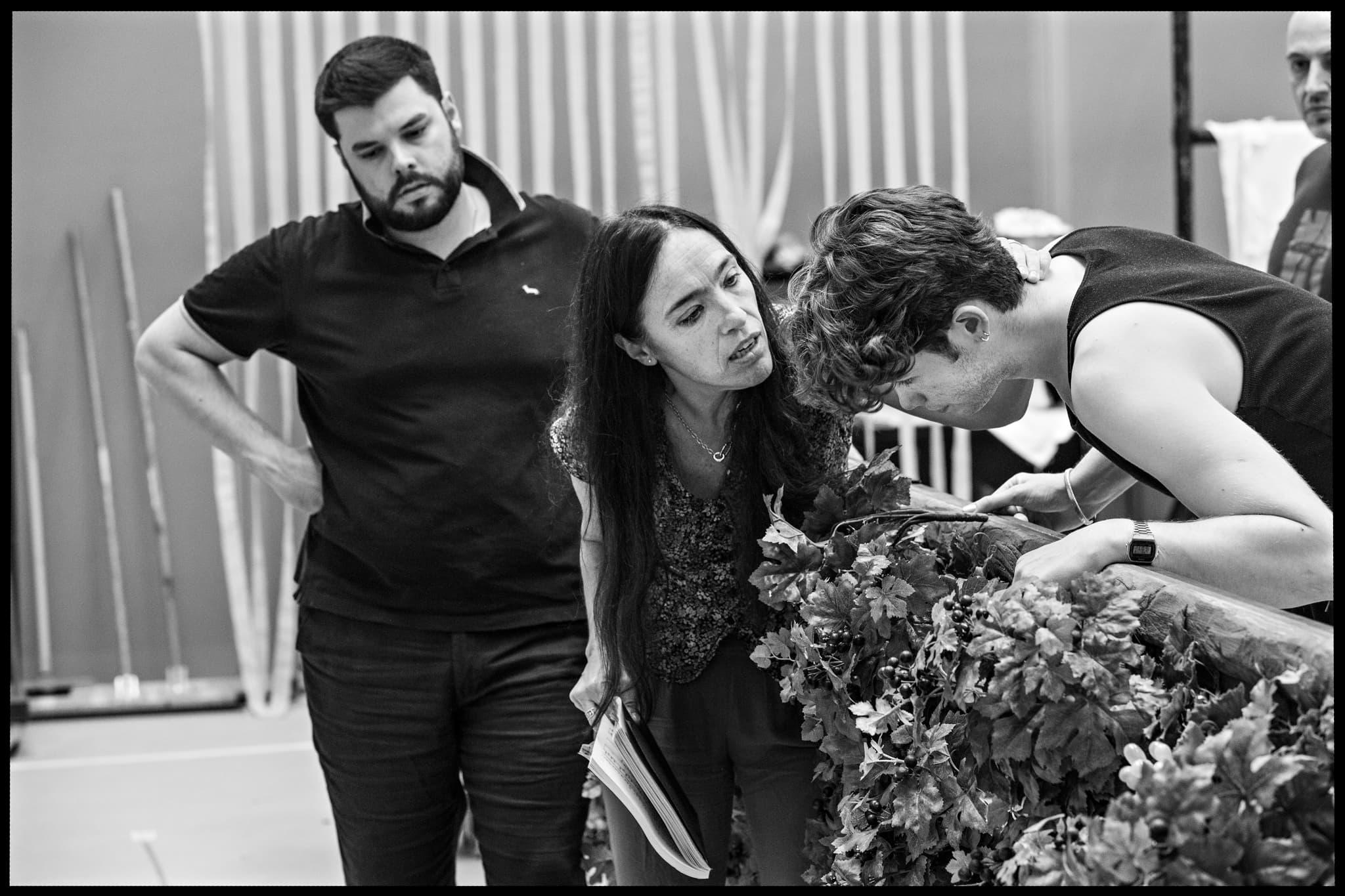
Accabadora - Festival d'Aix-en-Provence 2026 © Jean-Louis Fernandez
